Alterations, Fit & Preservation
Best Wedding Dress Bustle Types for Your Train (2026)
The right bustle depends on your train length, your fabric, and who is fastening it in a rushed bridal suite. Here is every style ranked — with honest costs, real fabric rules, and the look each creates.
Best Wedding Dress BustleAmerican vs French BustleBustle for Cathedral TrainWedding Dress Bustle CostChiffon & Satin Bustles
The quick verdict
Six bustle styles ranked by versatility, matched to train length and skirt fabric — with real costs, honest tradeoffs, and day-of guidance from leading bridal salons.
- Best overall
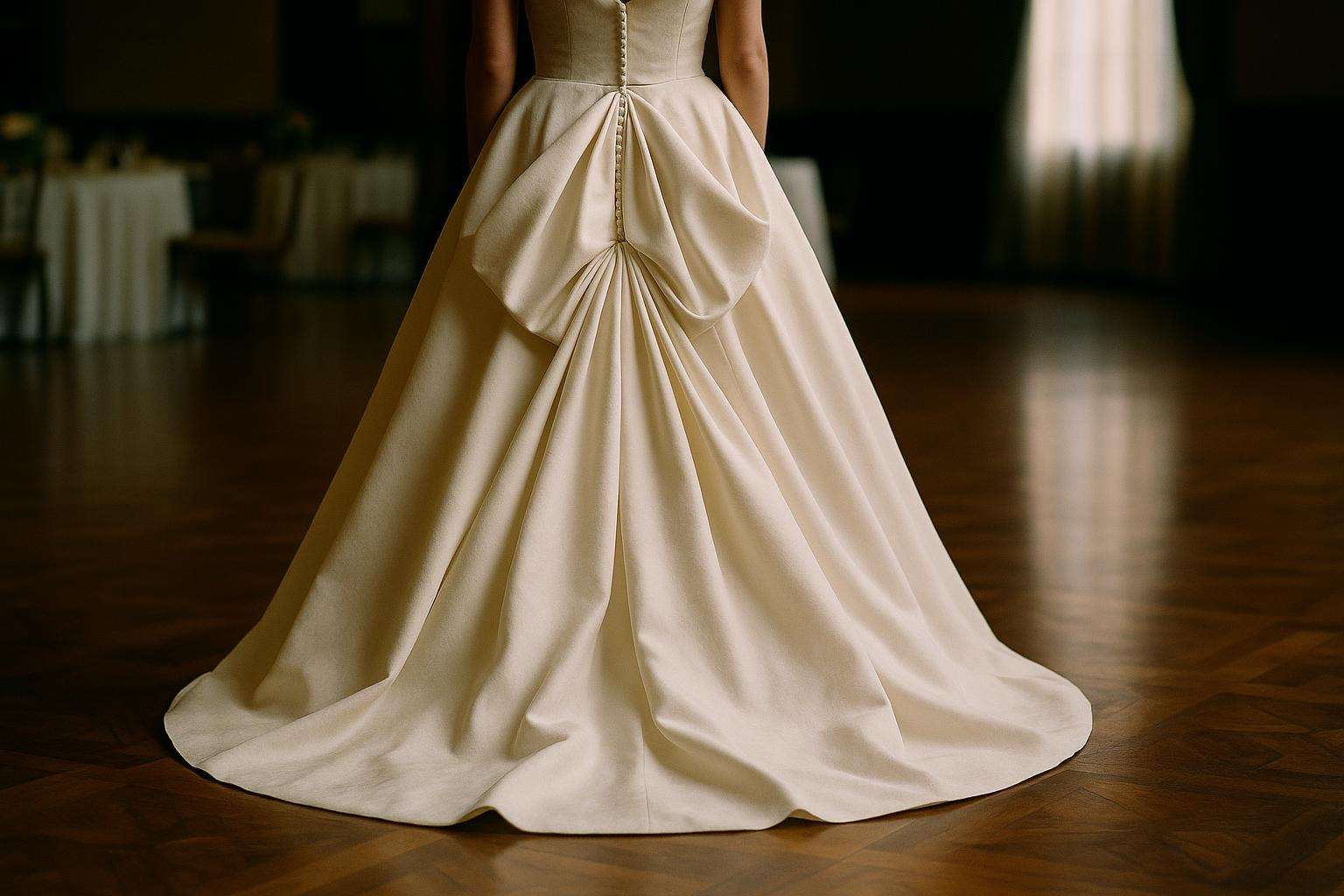
- American Over-Bustle — The most popular style in the United States for good reason — it works on the widest range of silhouettes, is straightforward to attach, and the cascading back folds photograph beautifully from every angle.
- Best value
- French Under-Bustle — Comparable cost to the American bustle but delivers a cleaner exterior finish on fitted and mermaid silhouettes, making it the most cost-effective choice for brides who want a seamless back line without paying for a more complex mechanism.
- Best for Cathedral or royal train on a full ball gown
- Ballroom Bustle — When the train is very long and the bride wants total freedom of movement at the reception with zero train management, the ballroom bustle is the only style that conceals the train completely — essential for brides on a dance-heavy evening.
How we evaluated
Each bustle style was evaluated against train length compatibility, fabric suitability, day-of attachment complexity, visual outcome, and cost range using published guidance from active bridal salons and designers including Kleinfeld Bridal, Alteration Specialists NYC, Moonlight Bridal, Lovella Bridal, and Kelly Faetanini. Pricing reflects national ranges published in 2025–2026 and is verified against multiple independent salon sources. Rankings reflect versatility and suitability across the broadest range of gowns — a style ranked first is the most broadly applicable, not categorically superior for every bride.
- Train length compatibility. Whether the style holds securely at sweep, court, chapel, cathedral, and royal train lengths, and the number of attachment points required at each length.
- Fabric suitability. Whether the bustle mechanism holds on the fabric — lightweight (chiffon, organza, tulle) versus heavy (satin, Mikado, structured brocade, beaded) — without causing stress or distortion.
- Day-of complexity. How many attachment points must be matched and in what sequence, how much time the process takes, and how trained the helper must be to execute it correctly under reception pressure.
- Visual outcome. How the gathered fabric looks once bustled — cascading folds, clean two-layer hem, full concealment, ruched curtain effect, or vintage petal cascade — and whether the result suits the gown's design and the bride's aesthetic intention.
- Cost and alteration labor. National cost ranges (2026) and metro-market ranges from published salon pricing; per-point pricing where applicable.
Rating scale: 5.0 = most broadly versatile and recommended; ratings reflect overall suitability across gown types, not elegance or prestige of any one style.
Last verified .
At a glance
| # | Name | Rating | Best for | Pricing |
|---|---|---|---|---|
| 1 | American Over-Bustle | 5.0 | A-line, ball gown, and flowy silhouettes on chapel or cathedral trains; fabrics including chiffon, lace, and soft tulle where back detail at the waist should remain visible. | $75–$150 nationally; $150–$400 in NYC metro |
| 2 | French Under-Bustle | 4.8 | Mermaid, trumpet, and sheath silhouettes; plain satin, structured crepe, and silk gowns where no external hardware should be visible; heavy cathedral trains where weight distribution matters. | $100–$200 nationally; $200–$500 in NYC metro |
| 3 | Ballroom Bustle | 4.5 | Full ball gown and structured A-line silhouettes with chapel or cathedral trains; brides planning a heavily dance-focused reception; gowns by Maggie Sottero or Martina Liana with multiple skirt layers. | $200–$400 nationally; $400–$1,000+ in NYC metro |
| 4 | Austrian Drawstring Bustle | 4.2 | Lightweight chiffon and organza A-line or sheath gowns with chapel or cathedral trains; brides wanting a back silhouette that reads as intentional design rather than practical alteration. | $150–$300 nationally; $300–$600 in NYC metro |
| 5 | Victorian Bustle | 3.9 | Heritage-influenced, lace, or romantic A-line gowns with chapel or cathedral trains; brides whose aesthetic references vintage or Victorian bridal silhouettes. | $120–$250 nationally; $250–$500 in major metro markets |
| 6 | Wrist Bustle (Loop Bustle) | 2.8 | Sweep or court trains on lightweight chiffon or tulle gowns; brides who want a specific first-dance train moment and do not require a full-evening hands-free bustle solution. | $0–$30 nationally |
American Over-Bustle
The most popular bustle in the United States — versatile, elegant, and forgiving to attach.
Editor's pick
The American bustle — also called the over-bustle — is the most widely used bustle style across American bridal salons, and for demonstrable reasons: it works on the broadest range of silhouettes, creates a beautiful cascading back effect that photographs well from every angle, and is among the most forgiving styles for the bridesmaid tasked with fastening it. The train is lifted and secured on the outside of the gown near the waistline using hooks, loops, and coordinating buttons or pearls — typically at one, three, or five attachment points — so the gathered fabric flows down the back of the skirt in soft, layered folds. The hardware becomes part of the design: small pearl or fabric-covered buttons mark the attachment points and are sewn to coordinate with the gown's existing detail. Bridal Atelier Montclair — a New Jersey boutique carrying Anne Barge and Savin London — notes that the American bustle is the natural choice for any gown where waistline beading, lace, or back detail should remain visible and celebrated, because the over-bustle frames rather than obscures the back. The cascade of fabric creates a statement reception silhouette that retains the sense of drama from the ceremony while freeing the hem entirely. At the final fitting, the Maid of Honor attaches the loops to the buttons working outward from centre — the sequence is simple and repeatable, even in a dim bridal suite. Nationally, the American bustle runs $75 to $150 at most independent tailors and bridal salons; in New York City and other major metro markets, expect $150 to $400 depending on the number of points and fabric complexity.
Strengths
- Works on the widest range of silhouettes — A-line, ball gown, fit-and-flare, and high-low hems.
- Straightforward day-of attachment: loops match to buttons from centre outward, low error risk under pressure.
- Creates a beautiful, dramatic back silhouette that reads well in reception photography.
- Small pearl or fabric-covered buttons at attachment points become a decorative design element.
Weaknesses
- Concentrates the train's weight at the waistline attachment points — not the best structural choice for very heavy or heavily beaded cathedral trains, where the French bustle distributes weight more evenly.
- Best for
- A-line, ball gown, and flowy silhouettes on chapel or cathedral trains; fabrics including chiffon, lace, and soft tulle where back detail at the waist should remain visible.
- Pricing
- $75–$150 nationally; $150–$400 in NYC metro
Source: Bridal Atelier Montclair — Bustle Styles Explained: French vs. American · Visit American Over-Bustle
French Under-Bustle
The seamless, hidden-hardware bustle — best for fitted and mermaid silhouettes.
Best value
The French bustle — the under-bustle — is the architectural counterpart to the American: the train folds underneath the skirt and is secured via colour-coded ribbons or numbered ties sewn into the gown's lining, so the exterior remains completely smooth with no visible hardware. The result is a graceful tiered hem with soft additional volume at the back — understated, polished, and ideal for any silhouette where external buttons or cascading folds would add unwanted bulk or disrupt a fitted line. Where the American bustle celebrates the gathered fabric as a visual statement, the French bustle subordinates it entirely to the gown's primary silhouette. Alteration Specialists NYC — operating across Manhattan and Brooklyn — recommends using colour-coded ribbons rather than numbered tags on French bustles: matching pairs by colour is faster and less error-prone than reading numbers in a rushed bridal suite. The colour-coding system is a practical refinement born from daily experience with complex multi-point French bustles on heavily trained mermaid and trumpet gowns. Slightly more attachment points are typically required than for a comparable American bustle, which accounts for the marginally higher cost nationally — $100 to $200, and $200 to $500 in major metro markets. For very heavy satin or beaded trains, the French bustle's internal mechanism distributes weight across the hem more evenly than the American bustle's waistline concentration, making it the structurally sounder choice on the heaviest gowns.
Strengths
- Completely hidden hardware — no visible buttons or loops on the exterior, preserving a clean back silhouette.
- Distributes heavy train weight across the hem more evenly than the American over-bustle.
- Colour-coded ribbon system (recommended by Alteration Specialists NYC) speeds day-of attachment.
- Ideal for mermaid and trumpet silhouettes where back volume would otherwise distort the fitted line.
Weaknesses
- Requires more attachment points than a comparable American bustle, increasing both alteration time and cost; slightly more complex to fasten correctly without practice.
- Best for
- Mermaid, trumpet, and sheath silhouettes; plain satin, structured crepe, and silk gowns where no external hardware should be visible; heavy cathedral trains where weight distribution matters.
- Pricing
- $100–$200 nationally; $200–$500 in NYC metro
Source: Alteration Specialists NYC — How Much Does it Cost to Bustle a Wedding Dress? · Visit French Under-Bustle
Ballroom Bustle
Full concealment — the train disappears completely for a classic floor-length reception look.
The ballroom bustle is the most thorough of all bustle styles: multiple hooks, buttons, or ribbons lift the entire train flush underneath the gown so that it vanishes entirely, transforming the reception silhouette into a clean floor-length dress with no visible train at all. This is not a variation on the American or French style — it is a distinct outcome, and the right choice for any bride who wants maximum freedom of movement with zero train management across an entire evening of dancing. The technique requires the highest number of attachment points of any bustle style, which increases both alteration time and day-of complexity. Princess Bridals in Long Island, which publishes detailed bustle education resources, notes that the ballroom bustle works on virtually any silhouette because it hides the train without altering the gown's exterior appearance — a distinction that matters when the bride has chosen a gown specifically for its front and back lines. The helper must know the sequence of attachment points precisely; out-of-order fastening on a twelve-point ballroom bustle can cause puckering or uneven distribution that is visible from across the room. Per Alteration Specialists NYC, costs run $200 to $400 nationally and $400 to $1,000 or more in the New York City metro for heavily layered or beaded gowns with many bustle points.
Strengths
- Completely conceals the train — the reception silhouette is a clean floor-length dress with zero train management required.
- Works across the widest range of silhouettes because it hides the train without altering the gown's design lines.
- Maximum freedom of movement for dancing — no fabric to manage, step over, or have caught underfoot.
- Preferred for full ball gown silhouettes at formal receptions where a drama-free evening is the priority.
Weaknesses
- The most expensive standard bustle style and the most demanding to attach correctly — requires the most attachment points and the most precisely trained helper; mistakes are visible.
- Best for
- Full ball gown and structured A-line silhouettes with chapel or cathedral trains; brides planning a heavily dance-focused reception; gowns by Maggie Sottero or Martina Liana with multiple skirt layers.
- Pricing
- $200–$400 nationally; $400–$1,000+ in NYC metro
Source: Princess Bridals — Wedding Dress Bustle Guide: Types and Styles for Every Bride · Visit Ballroom Bustle
Austrian Drawstring Bustle
Architectural and distinctive — vertical ruched folds via a single drawstring pull.
The Austrian bustle is the most visually distinctive of all the standard styles, and the one with the strictest fabric requirement. A drawstring mechanism is sewn into the train; when the cord is pulled, the fabric gathers vertically into soft, curtain-like ruched folds — an effect inspired by Austrian theatre drapery, applied symmetrically at centre back or drawn asymmetrically to one side for an editorial, sculptural finish. Because activation involves pulling a single cord rather than matching multiple loops to buttons, it is one of the more bridesmaid-friendly styles to operate in practice, despite its complex appearance. The fabric constraint is non-negotiable: Moonlight Bridal's 2026 bustle guide is explicit that the Austrian drawstring works only on lightweight fabrics — chiffon and organza are the ideal — and cannot hold securely on heavy satins, Mikado, or any structured brocade. Attempting an Austrian bustle on the wrong fabric is a common source of mid-reception bustle failures. Darianna Bridal and Tuxedo in Warminster, Pennsylvania — a salon that publishes detailed bustle education guides — recommends the Austrian drawstring specifically for brides who want a distinctive back statement that sets their reception look apart from the standard cascade or tiered hem. Cost is higher than American or French styles, reflecting the more involved sewing labour: $150 to $300 nationally, and $300 to $600 in major metro markets.
Strengths
- Creates a highly distinctive vertical-ruched back that looks unlike any other bustle style — an editorial statement in its own right.
- Single-cord activation is simpler to operate on the day than multi-point button or ribbon systems.
- Can be applied asymmetrically for an intentional sculptural effect.
- Beautiful on lightweight chiffon and organza gowns where the fabric's natural drape enhances the gathered curtain effect.
Weaknesses
- Strictly fabric-limited — cannot be used on heavy satins, Mikado, or structured brocade; attempting it on the wrong fabric risks a bustle failure mid-reception. Higher cost than American or French for comparable train length.
- Best for
- Lightweight chiffon and organza A-line or sheath gowns with chapel or cathedral trains; brides wanting a back silhouette that reads as intentional design rather than practical alteration.
- Pricing
- $150–$300 nationally; $300–$600 in NYC metro
Source: Moonlight Bridal — 9 Types of Wedding Dress Bustles: How to Choose the Right Style (2026 Guide) · Visit Austrian Drawstring Bustle
Victorian Bustle
A romantic, heritage-inspired cascade of petal folds running the full length of the back.
The Victorian bustle is a close relative of the French under-bustle, but with a distinctly different visual outcome: rather than attaching only at the waistline, the train is gathered and fastened at multiple points running down the length of the gown's back, creating a cascading series of petal-like folds along the entire back seam from waist to hem. Essense of Australia describes the effect as elegant and vintage-inspired — the gathered train produces a layered drape that references the bustle silhouettes of the 1870s and 1880s, making it the most heritage-register choice in this ranked list. The Victorian bustle requires more attachment points than a standard French bustle — each point down the back must be precisely placed so the folds align symmetrically — which increases both the seamstress's labor and the day-of attachment time. It suits brides whose gown carries vintage or romantic design elements: lace appliqué, illusion backs, covered buttons down the spine, or a silhouette influenced by Edwardian or Victorian bridal fashion. Independent boutique salons like Bridal Atelier Montclair, which carries heritage-leaning designers including Anne Barge and Jesús Peiró, tend to offer the Victorian bustle as a choice for gowns in this aesthetic register. Cost runs $120 to $250 nationally, rising toward the upper range with more attachment points, and $250 to $500 in major metro markets.
Strengths
- Creates a genuinely unique back silhouette — cascading petal folds running the full spine length, unlike any standard bustle style.
- Deeply heritage-appropriate for vintage, Edwardian, or romantic gown aesthetics.
- Works well on A-line silhouettes where the back seam provides multiple clean attachment points.
- Elevates a gown with a plain back into a reception statement piece.
Weaknesses
- More attachment points than a standard French bustle, increasing alteration cost and day-of complexity; the sequential attachment down the full back requires a more practiced helper and more time between ceremony and reception.
- Best for
- Heritage-influenced, lace, or romantic A-line gowns with chapel or cathedral trains; brides whose aesthetic references vintage or Victorian bridal silhouettes.
- Pricing
- $120–$250 nationally; $250–$500 in major metro markets
Source: Essense Designs — How to Bustle Your Wedding Dress · Visit Victorian Bustle
Wrist Bustle (Loop Bustle)
No alteration required — a fabric loop on the wrist keeps a light train off the floor.
The wrist bustle is the simplest and least expensive solution in this list: a small fabric loop is sewn or attached to the train so the bride can slip it over her wrist to hold the hem off the floor without any permanent structural alteration to the gown. It costs almost nothing — typically $0 to $30 — and can be reversed or removed entirely, which makes it the only style that does not commit the gown to a permanent modification. For very light or short trains, it is a practical and proportionate solution. However, the wrist bustle has real limitations that brides should weigh honestly before choosing it as a substitute for a sewn bustle on a longer or heavier train. It requires the bride to hold her wrist at a specific angle continuously or to loop it before any activity that requires both hands; over a four- to five-hour reception, the cumulative wrist fatigue is a frequent complaint. The Knot notes that the fabric loops found on many gowns were originally designed as garment-bag hanging loops during transit — not as reception bustle mechanisms — so their durability under the full weight of an extended train and hours of wear varies considerably by construction. Lovella Bridal in Glendale, California — a luxury salon with more than fifty years in business — notes that the wrist loop is best reserved for the first dance specifically, rather than as a full-reception solution, even on lighter trains. For sweep or court trains on a bride who wants a brief, cinematic train moment and then freedom of movement, it is a legitimate, zero-alteration option.
Strengths
- Near-zero cost — $0 to $30 nationally — and requires no permanent alteration to the gown.
- Completely reversible; can be removed at any point in the reception.
- Useful for a brief first-dance train moment on very light trains without committing to a full sewn bustle.
- The only option that preserves the full trail of the gown for specific choreographed moments.
Weaknesses
- Causes wrist fatigue over a long reception and provides no hands-free solution — the bride must always be conscious of her wrist position. Not suitable for cathedral or royal trains; loop durability on heavy trains varies significantly by construction.
- Best for
- Sweep or court trains on lightweight chiffon or tulle gowns; brides who want a specific first-dance train moment and do not require a full-evening hands-free bustle solution.
- Pricing
- $0–$30 nationally
Source: Lovella Bridal — How to Bustle Wedding Dress, What is Bridal Dress Bustle · Visit Wrist Bustle (Loop Bustle)
Which should you choose?
Bride in a full ball gown with a cathedral train · formal church or ballroom wedding
Goal:Complete freedom of movement for a full evening of dancing with no train management
Ballroom Bustle — Only the ballroom bustle conceals the train entirely; on a heavily layered ball gown at a formal ballroom reception, any other style still requires some train awareness.
Bride in a mermaid or trumpet silhouette with plain satin · intimate wedding or destination wedding
Goal:Maintain the gown's clean back line without visible hardware or back bulk at the reception
French Under-Bustle — The French bustle hides all hardware inside the lining and distributes the train's weight evenly — the only style that preserves a smooth, seamless exterior on a fitted silhouette.
Bride with a lightweight chiffon A-line gown who wants a distinctive back statement · garden or outdoor wedding
Goal:A reception back silhouette that looks like intentional design rather than a practical alteration
Austrian Drawstring Bustle — On chiffon, the drawstring creates soft vertical ruches that read as a design feature — and single-cord activation is easy for the MOH to execute at the ceremony-to-reception transition.
Frequently asked
What is the best wedding dress bustle for a cathedral train?
For a cathedral train — which extends 6 to 7.5 feet from the waistline — the best bustle depends on silhouette. A mermaid or trumpet gown with a cathedral train is best served by the French under-bustle: internal colour-coded ribbons distribute the considerable weight of the train evenly across the hem and the hidden hardware keeps the fitted back line intact. For an A-line or ball gown, the American over-bustle creates a beautiful cascade. When the bride wants complete freedom of movement with no visible train at all, the ballroom bustle is the only style that conceals the train entirely — at a cost of $200 to $400 nationally. Kleinfeld Bridal, which employs more than 100 alterations staff at its New York flagship, advises discussing bustle style at the first alterations appointment for any cathedral-trained gown, as the number of attachment points (potentially twenty or more) makes it a significant alteration that must be planned early.
What is the difference between an American bustle and a French bustle?
The American bustle lifts the train and secures it on the outside of the gown near the waistline, creating a visible cascade of layered folds flowing down the back. The French bustle folds the train underneath the skirt and secures it with internal colour-coded ribbons, so the exterior remains seamless with no visible hardware. The key practical difference is silhouette impact: the American bustle adds volume and drama to the back, while the French bustle maintains a clean, smooth exterior line. American bustles suit A-line and ball gown silhouettes; French bustles are preferred for mermaid and trumpet silhouettes where additional back volume would distort a fitted line. Cost is broadly comparable — $75 to $150 for American, $100 to $200 for French, at most national salons.
Can you bustle a chiffon wedding dress, and which style is best?
Yes — chiffon is one of the most bustle-friendly fabrics because it is lightweight and drapes naturally. The American over-bustle, the Austrian drawstring, and the French under-bustle all work well on chiffon, and the Austrian drawstring is particularly beautiful on chiffon because the gathered vertical ruches read as a design element rather than a practical fold. The wrist loop is also viable on a very light chiffon train. The only style to approach with caution on chiffon is the ballroom bustle: the many attachment points required to conceal a full train are structurally sound, but confirm with the seamstress that the chiffon layers are stable enough to bear the stress across a long reception. Essense of Australia advises that two brides in the same chiffon gown may still require different bustle approaches depending on height and how the fabric drapes on that specific body.
Who should learn how to bustle a wedding dress, and when?
The Maid or Matron of Honor — the person who will bustle the gown on the wedding day — should attend the final alterations fitting so the seamstress can demonstrate the exact sequence in person. Kelly Faetanini, the New York bridal designer known as the youngest to show at New York Bridal Fashion Week, explicitly advises this. Lovella Bridal in Glendale, California records a video on the bride's phone during the final fitting and shares it with the full bridal party so everyone can review it before the wedding. Darianna Bridal and Tuxedo in Warminster, Pennsylvania recommends the same practice. Plan at least three to five minutes in the ceremony-to-reception transition for a simple American or French bustle; Austrian and ballroom styles need more time. Pack a crochet hook and large safety pins in the emergency kit as backups.
How much does it cost to add the best bustle to a wedding dress in 2026?
Bustle cost in 2026 depends on style, train length, fabric complexity, and location. A wrist loop costs $0 to $30 and requires no permanent alteration. A standard American over-bustle runs $75 to $150 nationally and $150 to $400 in the NYC metro. A French under-bustle costs $100 to $200 nationally and $200 to $500 in major metro markets. A Victorian multi-point bustle runs $120 to $250. An Austrian drawstring costs $150 to $300 nationally. A ballroom full-concealment bustle is the most expensive: $200 to $400 nationally and $400 to $1,000 or more in New York City for heavily beaded or layered gowns, per Alteration Specialists NYC. Overall bridal alteration packages — hem, bustle, and fit adjustments — average $500 to $700 nationally and $600 to $1,500 in New York City.
What is the best wedding dress bustle for a satin or Mikado gown?
For heavy fabrics like duchess satin, Mikado, or structured brocade, the French under-bustle or ballroom bustle are the strongest choices. Both use internal mechanisms that distribute the train's considerable weight across multiple points through the hem, rather than concentrating it at the waistline as the American over-bustle does. The Austrian drawstring is not a viable option on heavy fabrics — Moonlight Bridal's 2026 bustle guide is explicit that the drawstring mechanism cannot hold securely on satin or Mikado and should not be attempted on these materials. The wrist loop is also unsuitable for anything heavier than a very light court train. When in doubt on a heavy gown, ask the seamstress to demonstrate the bustle fully fastened at the fitting before confirming the style — how the fabric hangs under its own weight tells the seamstress more than the style label alone.