The Wedding Dress
Champagne Wedding Dress: The Warm-Toned Alternative to White
Who the warm golden hue flatters, how it photographs, and how to style metals and accessories against a champagne gown.
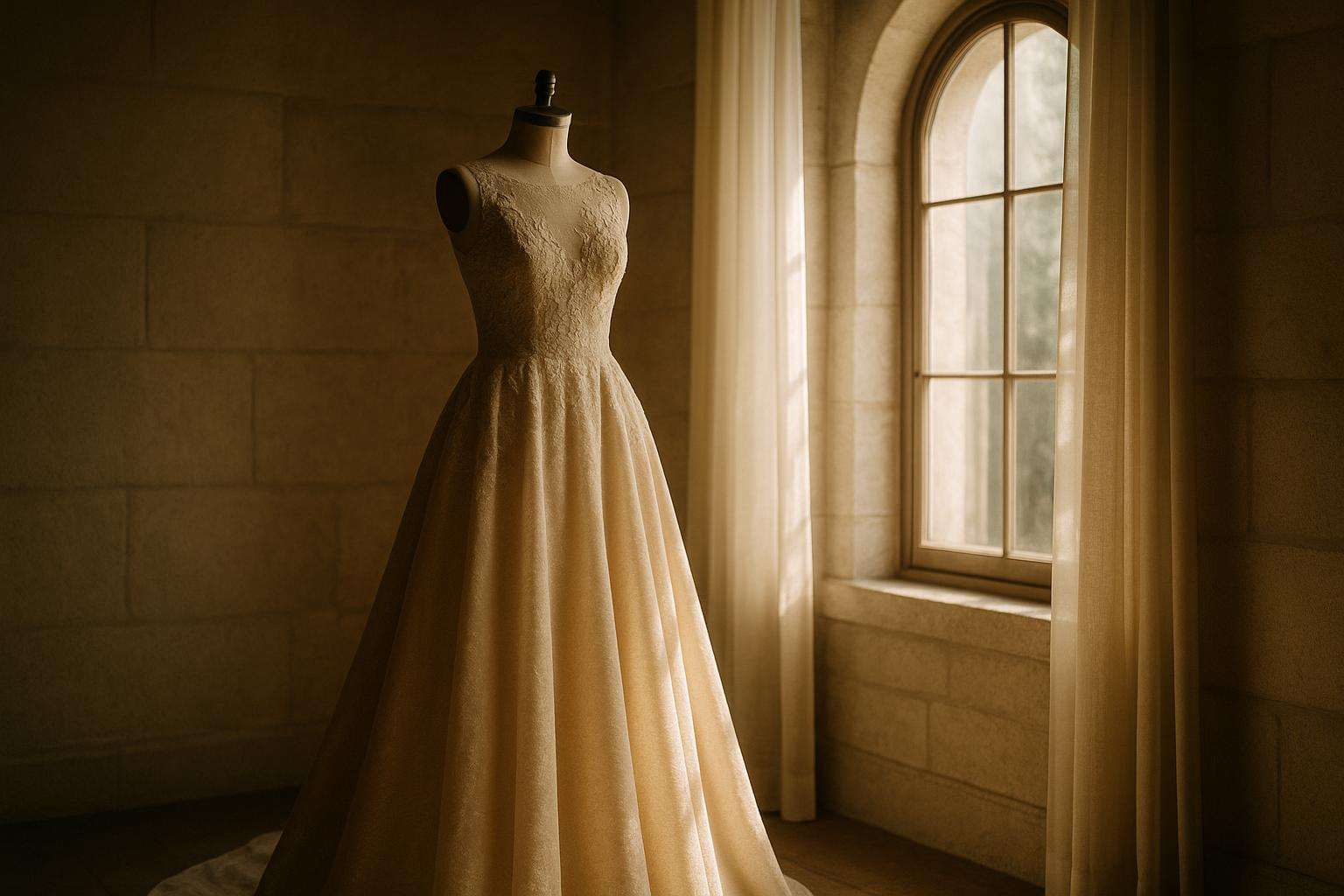
A champagne wedding dress is defined by its warm golden-beige undertone — richer than ivory, earthier than gold, and more universally flattering than either. It glows under candlelight and venue warmth, photographs with depth and dimension, and pairs most naturally with gold and rose-gold accessories. The hue suits virtually every skin tone when matched to the right depth of champagne.
What Is a Champagne Wedding Dress, Exactly?
Champagne is not simply “off-white with a yellow cast.” The colour takes its name from the warm golden-beige of fine sparkling wine — a specific register that sits clearly between the cooler creaminess of ivory and the assertive warmth of antique gold. Its defining characteristic is a visible golden undertone that catches and holds light differently from either of its neighbours on the bridal colour spectrum.
The shade spans a range. At the lighter end, champagne trends toward warm beige with a subtle gold shimmer — ideal for lace appliqués and pearl beading, both of which it visually amplifies. At the deeper end, it moves toward antique gold without crossing into the overtly metallic territory that characterises true gold bridal gowns. Where you land on that spectrum should be guided by your skin tone, your venue lighting, and your desired level of warmth in the finished look.
Bridal retailers name their own iterations of this colour, so expect to encounter labels like “rum,” “gardenia,” “light gold,” “antique champagne,” and “golden ivory” for gowns that occupy the same general territory. Always compare swatches side by side in natural daylight before committing — salon lighting skews warm and can make distinctions between shades difficult to read accurately.
How Does Champagne Compare to Ivory, Blush, and Gold?
These four warm-adjacent bridal shades are routinely confused, yet each carries a distinct visual signature that affects how the gown reads at the altar and in photographs.
| Shade | Undertone | Best Lighting | Best Skin Tones | Pairs With |
|---|---|---|---|---|
| Champagne | Warm golden-beige | Candlelight, chandeliers, open shade | Medium, olive, deep; pale if light champagne chosen | Gold, rose gold, pearls, amber |
| Ivory | Creamy neutral to slightly warm | Natural daylight, bright venues | Fair, medium; cool and warm undertones | Silver, pearl, gold, white gold |
| Blush | Soft pink-red | Outdoor daytime, garden settings | Fair to medium; cooler undertones | Rose gold, white gold, dusty rose florals |
| Gold | Rich, saturated yellow-gold | Evening, low-light, dramatic settings | Medium, olive, deep skin tones | Gold, deep jewel-tone accessories |
The clearest takeaway from this comparison: champagne occupies the most forgiving position. It is warmer than ivory without the blowout risk of stark white, softer than gold without its seasonal limitations, and richer than blush without its pink-specific pairing constraints. Champagne is generally considered the most universally accessible of the warm alternatives — as bridal colour specialists at Simply Blush Bridal note, it suits a wider range of complexions than gold precisely because its warmth is restrained enough not to wash out cooler skin.
Does a Champagne Wedding Dress Flatter My Skin Tone?
Champagne’s commercial durability rests on one genuine virtue: its warm golden undertone catches natural light in a way that adds a soft glow to virtually every complexion. That said, the depth of the champagne matters enormously — not all champagne gowns behave the same way against different skin.
Fair and light skin. Brides with cool fair undertones (pink or blue at the wrist) do best with the palest end of the champagne spectrum — shades labelled light champagne, blush champagne, or soft gold rather than antique champagne or deep gold. The lightest champagnes add warmth without overwhelming a pale complexion. Brides with warm fair undertones can carry a richer champagne comfortably.
Medium and olive skin. Classic champagne creates a harmonious glow effect against medium complexions. Warm-undertoned olive skin in particular resonates with champagne’s golden notes, producing a rich, sun-kissed appearance that reads beautifully on camera. Medium-toned brides have the widest latitude in champagne depth.
Tan, deep, and dark skin. Champagne is among the most striking choices for deeper complexions. The contrast between the warm gown and a rich complexion amplifies both — the gown appears more luminous and the complexion appears more radiant. Richer, deeper champagne or antique gold shades are particularly recommended for this range, since the lightest champagnes can look washed out when worn against deep skin rather than pale.
The most useful practical advice from multiple bridal salons: always view the gown in natural light and request fabric swatches against your bare décolletage, since individual designers apply their own naming conventions. Martina Liana, for example, offers a “Rum” underlay — a warm amber-champagne tone used beneath ivory lace overlays — that reads as a distinctly different depth of champagne than what another label might call “light gold.”
How Does a Champagne Gown Photograph?
Photography is one of the strongest arguments for champagne over white or ivory. Pure white gowns carry optical brighteners in the fabric — they reflect UV light and can overexpose in direct flash or bright outdoor sun, losing all fabric detail in the final image. Champagne, lacking those brighteners, holds tonal depth even when backlit, lending the gown a three-dimensional quality in both colour and black-and-white photography.
Champagne performs particularly well in the two most popular venue lighting environments: warm indoor light (chandeliers, candelabras, Edison string lights) amplifies the golden undertone and makes the gown glow rather than glare; outdoor open-shade photography preserves the colour accurately without the colour temperature conflicts that can make pure white appear blue or pale ivory appear yellow. Under tungsten or candlelight, champagne reads as deeply warm and luxurious — a quality that translates directly into timeless editorial-style images.
For couples shooting in mixed or cooler lighting (overcast exteriors, venues with cool fluorescents), the champagne undertone can appear less defined, but it will still read as a rich warm off-white rather than the flat grey that can afflict ivory gowns in unflattering light.
Which Designers Make Champagne Wedding Dresses?
Martina Liana — led by Chief Creative Officer Martine Harris and operating under the Essense of Australia umbrella — is one of the most technically rigorous labels in the accessible-couture champagne space. The 2026 collection incorporates delicate lace appliqués, shimmering beadwork, corset-inspired boning, and lace-up backs. Style 1490, an A-line gown with chevron beaded spaghetti straps, a balconette bodice, glitter tulle sweeping train, and an illusion back, is available with a Rum (warm amber-champagne) underlay that achieves the champagne warmth beneath an ivory lace overlay. Gowns retail from approximately $2,850 to $5,600 at authorized retailers including Kleinfeld Bridal (New York), Wedding Atelier NYC, and True Society Bridal Shops nationally.
Stella York, part of the same Essense of Australia family and founded in 2011, targets accessible luxury: Spring 2025 collection gowns are priced approximately $1,400–$2,100. The label is known for on-trend silhouettes — fit-and-flare, A-line, mermaid, ball gown — in premium fabrics including French lace, chiffon, charmeuse, and tulle. Champagne-toned Stella York gowns frequently feature intricate lace detailing over warm-toned underlays, illusion tulle with vine-like lace motifs, and floral appliqués. Style 6933 (a vintage lace bodycon fit-and-flare) and Style 7732 (off-the-shoulder lace and tulle) represent the label’s approach to textural richness at the accessible price tier. Available at Alexandra’s Boutique, The Wedding Shoppe in Minnesota, and directly via essensedesigns.com/stella-york.
Hayley Paige returned to the bridal market in 2025 following a multi-year legal dispute. Her Spring 2026 collection, REIN, debuted at New York Bridal Fashion Week on April 7, 2026, drawing on equestrian tradition, Belle Époque ornamentation, and ballroom aesthetics. The collection features basque waists, exposed corsetry, dimensional floral appliqués, and sparkle tulle — design vocabulary that translates naturally into champagne and warm-gold fabrications. Available at The Bridal Collection in Colorado, Kleinfeld Bridal in New York, and pre-owned at Luxe Redux Bridal.
Maggie Sottero maintains a dedicated champagne filter through its Maggie’s Closet store locator, connecting brides with local authorized boutiques carrying champagne styles across multiple silhouettes and price points. David’s Bridal offers the most accessible entry point, with champagne gowns in multiple lengths, sleeve styles, and fabric options. Couture Candy online carries over 1,000 champagne styles including crystal-beaded gowns and plus-size options.
What Accessories Go Best with a Champagne Wedding Dress?
The metallic family is the strongest starting point. Gold — yellow gold and rose gold both — reinforces the warm golden notes already present in the fabric, creating a cohesive, luminous effect from head to toe. Silver and white gold introduce a deliberate modern contrast: the cooler metal plays against the warm gown in an editorial way that particularly suits minimalist brides and photographs well in black and white.
Gemstones that resonate with champagne fabric include pearls (the most classic choice), warm-toned crystals, amber, and topaz. Avoid cool-toned icy stones — aquamarine, pale sapphire — which can make the gown appear muddier and the accessory appear stark by comparison.
For veils, champagne-toned tulle with a single-shade gown reads as ultra-intentional and contemporary. An ivory veil over a two-toned gown (ivory lace over champagne underlay) is recommended to avoid visually weighing down the look — the veil should match the overlay, not the lining. Bridal accessories specialist Tania Maras recommends multi-tonal hair accessories — pieces combining light and dark metallic or beaded tones, such as her Sable and Cherry Blossom styles — to work with rather than against the warm complexity of champagne fabric.
For footwear: gold strappy heels echo the gown’s undertone most directly. Nude block heels matched to your own skin tone (not the gown) create an uninterrupted leg line under full skirts. Contrast choices — deep burgundy or emerald velvet heels — offer a season-appropriate accent for autumn and winter ceremonies without competing with the gown’s warmth. Avoid stark white shoes, which create a cool disconnect with a warm champagne fabric.
Bouquet companions: blush roses, ivory peonies, and dusty blue accent flowers are the most cited editorial pairings. For autumn and winter weddings, champagne also pairs well with sage, deep emerald, and rich burgundy florals.
Considered Counsel
Frequently asked
What is the difference between a champagne and an ivory wedding dress?
Ivory carries a creamy, slightly cool or neutral off-white tone, while champagne carries a distinctly warm golden-beige undertone that resembles the colour of fine sparkling wine. Under venue lighting, ivory softens and appears clean and bright, whereas champagne glows with warmth — particularly flattering under candlelight and chandeliers. At the fabric level, champagne reads as richer and more dimensional than ivory, and it pairs more naturally with gold-toned metals than with silver. The two shades are frequently confused in salon swatches, so always compare them side by side in natural light before making a final decision.
Does a champagne wedding dress look good on fair skin?
Yes, with one caveat: brides with fair skin and cool undertones (think pink or blue veins at the wrist) should gravitate toward the palest, most delicate end of the champagne spectrum — shades labelled 'light champagne,' 'blush champagne,' or 'soft gold' — rather than the deeper, more saturated antique-gold champagnes. Peachier champagne tones add warmth without overwhelming a pale complexion. Brides with warm fair undertones (golden or peachy) can carry a richer champagne beautifully. The key is always to view samples in natural daylight, since salon lighting skews warm and makes most shades look more champagne-adjacent than they truly are.
What jewelry and metals work best with a champagne wedding dress?
Gold is the most harmonious match for a champagne gown — both yellow gold and rose gold reinforce the warm undertones already present in the fabric, creating a cohesive, luminous effect. Silver and white gold introduce a deliberately modern contrast; the cooler metal plays against the warm gown in an editorial way that works particularly well in black-and-white photography. Gemstones that resonate with champagne fabric include pearls (classic, timeless), warm crystals, amber, and topaz. Avoid overtly cool or icy stones — sapphire, aquamarine — which can make the gown look muddier rather than richer. Accessory designer Tania Maras recommends multi-tonal hair pieces that blend light and dark tones to work with champagne's warm complexity.
How does a champagne wedding dress photograph?
Champagne is one of the most photogenic bridal colours precisely because it avoids the two extremes that cause problems on camera: the blow-out risk of stark white (optical brighteners in pure white fabrics can overexpose in direct flash or bright sun) and the flatness risk of very pale blush (which can disappear into neutral backgrounds). Champagne holds tonal depth even when backlit, lending the gown a three-dimensional quality that reads beautifully in both colour and black-and-white photography. Outdoor daytime shoots in open shade and indoor evening shoots under warm tungsten or candlelight both favour champagne. The golden undertone photographs as warmth and richness rather than yellow.
Is champagne or blush better for a wedding dress?
The choice depends on the mood and your colouring. Champagne reads as quietly luxurious and mature — its golden undertone suggests heritage fabrics, fine wine, and understated elegance. Blush leans romantic and soft, with pink and red undertones that evoke garden parties and fairytale silhouettes. For warm-undertoned brides who want colour without committing to an obvious departure from white, champagne is typically the stronger choice. For brides with cool undertones who want a subtle hint of colour, blush is more harmonious. Champagne also photographs with more tonal depth than blush, which can read as nearly white in certain lighting conditions. Both are appropriate for any season; champagne skews slightly more formal in evening settings.
What shoes should you wear with a champagne wedding dress?
Gold strappy heels are the most widely recommended pairing with a champagne gown: they echo the metal family of the gown's warm undertone and elongate the leg. Nude heels — matched as closely as possible to your own skin tone rather than to the gown — offer a clean, uninterrupted leg line and work especially well under full skirts. For a deliberate seasonal accent, deep burgundy or emerald velvet heels create a rich contrast without competing with the gown's warmth. Avoid stark white or silver shoes, which create a cool disconnect with the warm champagne fabric. Embellished block heels with pearl or crystal detail in warm tones balance comfort for long reception evenings while remaining cohesive.